BeforeAfter
Ergonomic implants, 425 ccDual plane
 Minimally invasive techniquePreservéA 2 cm micro-incision, no muscle detachment, under local anaesthesia with sedation.
Clinique Esthétique Ferrère
16 ter rue Ferrère, 33000 Bordeaux
Procedure 01
Silicone gel implants, round or anatomical, with the choice of incision and implant plane. One of the most frequent requests in cosmetic surgery.
Figures confirmed by the surgeon; they vary from case to case and are specified in consultation.
The essentials
Primary breast augmentation concerns the young girl or young woman with genetic hypotrophy of the mammary gland, a source of self-consciousness and of a lack of personal fulfilment. It may also be a personal request for comfort, to enhance and fill out a breast of average size.
The request may also arise after one or more pregnancies that have led to a loss of breast volume, sometimes accompanied by a loss of firmness or even skin laxity with sagging (ptosis).
The consultation may be prompted by a small but asymmetrical breast, sometimes with an abnormal deformed appearance: this may be a juvenile breast malformation such as tuberous breasts, which must not be overlooked.
Requests for implant replacement or revision of a breast augmentation are motivated by the natural wear of implants from 10 years onwards, or by a wish to improve the result in shape or volume, or to correct skin laxity with sagging. Also by a change or complication over the years, typically capsular contracture.
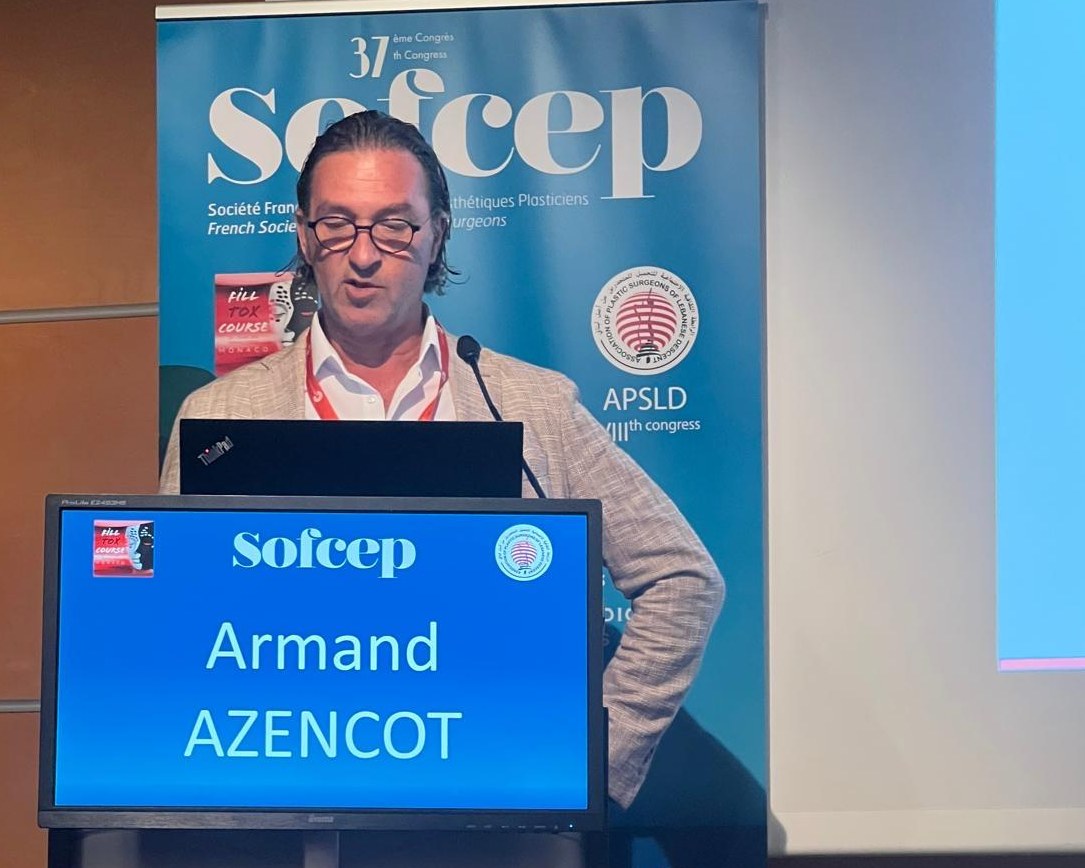
Dr Azencot performs breast augmentation in cosmetic as well as reconstructive surgery. He was among the first surgeons to develop the use of anatomical implants in cosmetic surgery and that of fat transfer in breast surgery, which has given him extensive experience in the treatment of difficult breasts: malformations, asymmetry, complicated implants, breast reconstruction.
The surgeon will listen to you to understand your motivations and your expectations.
The examination of your breasts is precise, with analysis of every element that may affect the result: skin quality, thickness of the subcutaneous tissue, volume of the existing gland, position of the areolas and of the inframammary fold, pectoral muscles, rib cage, any asymmetry.
The choice of implant is dictated by your measurements, like the making of a made-to-measure garment. The width, height and projection of the implant are chosen and proposed to you using a sizer placed in a trial bra. You can thus see and appreciate the size; it is then adjusted with you according to your expectations and to what is possible.
Your surgeon uses Crisalix 3D pre-operative photography: it reconstructs your bust in 3D from three photographs. Once the bust is reconstructed, a simulation of the augmentation — shape and volume — is proposed to help you picture the result. With the augmented reality tool, you see your simulated augmentation as in a mirror.
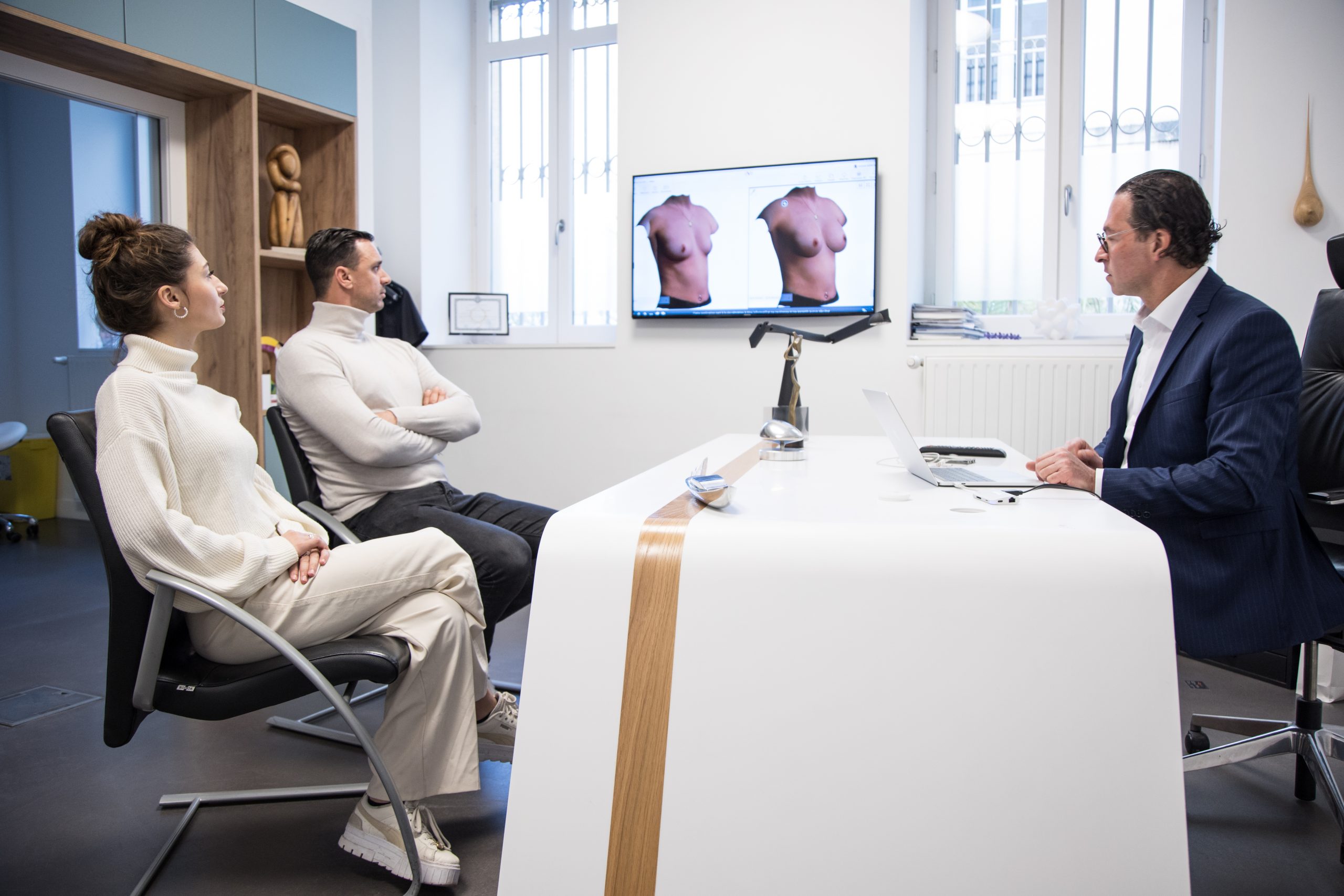
This is a decision aid which, of course, can in no way be contractual. A breast imaging assessment is also prescribed: mammography and ultrasound.
Three decisions are taken together in consultation: where to make the incision, where to place the implant, and what shape to give it.
The inframammary approach — a 4 to 5 cm incision in the fold of the breast — is always feasible. Its advantages are perfect control and visibility, no passage through the gland to create the pocket, and easy insertion of the implant. The scar is often of good quality and hidden under the breast. The scientific evidence favours it: it lowers the rate of capsular contracture, preserves nipple sensitivity and allows implants to be renewed through that same approach.
It is also the approach used in the Preservé technique, where it is shorter: 2 to 3 cm.
The areolar approach — an arc-shaped incision along the lower edge of the areola — is easily concealed and discreet; however the areola must be wide enough to introduce the implant. It offers good visibility and control; its drawbacks are the passage through the gland, with a higher rate of capsular contracture, and a rare possibility of scar distortion, or even visibility should the skin depigment. Revision surgery through this approach is more delicate.
The axillary approach is located in the armpit. Very well concealed and elegant, it must be performed under direct vision or with an endoscopic camera to ensure precise work. It is not always suitable for difficult cases or re-operations. Dr Azencot has mastered this technique and was a pioneer in placing anatomical implants through the axillary approach, under direct vision and endoscopically.
Put simply, the round implant works on volume, the anatomical implant sculpts shape. The round implant usually has a softer gel; it is indicated when full, rounded breasts are requested, or when the breast has supple skin and is already harmonious and well formed. It is also very suitable for revisions and implant exchanges.
The ergonomic implant is a recent technological development: its base is round, its gel soft and elastic, with a biodynamic behaviour that lets it take a very natural shape, standing or lying down.
This type of implant has shaken up the indication for anatomical implants, with results halfway between the round implants of the previous generation and anatomical implants.
It is today the most frequently proposed implant, and gives complete satisfaction in shape, naturalness, feel, longevity and safety. Its shell is nanotextured, as opposed to smooth or microtextured.
The anatomical implant brought the third dimension to breast augmentation. Teardrop-shaped, with a more cohesive gel, it has a stable shape and allows a very natural augmentation: a straight cleavage line, controlled breast depth, a harmonious lower curve. Whenever a new breast has to be shaped, it allows precise control of the shape — small juvenile breasts with tight skin, malformed or asymmetrical breasts, slightly sagging breasts.
Dr Azencot has been placing anatomical implants since 2002, the year of their introduction in France.
Since 4 April 2019, the French health authority (ANSM) has banned all macrotextured implants as a precautionary measure, as they may induce chronic inflammation in the capsule. We use microtextured anatomical implants, which give good implant stability with a very low rotation rate. In cosmetic surgery, the anatomical implant is reserved for particular or difficult cases. Your surgeon will inform you about all of this.
The choice of plane depends on tissue coverage, that is, on the thickness of the glandular cover in the décolleté.
To make things clear: the submuscular pocket is today created in dual plane — the upper half of the implant covered by the muscle, the lower half by the gland.
The subfascial plane replaces the subglandular plane: it lies under the fascia of the muscle, therefore better concealed, while remaining in front of the muscle fibres.
With the new implants with very soft shells and gels now available, the subfascial plane is used more and more, whenever it is possible.
The operation is performed in a clinic under general anaesthesia.
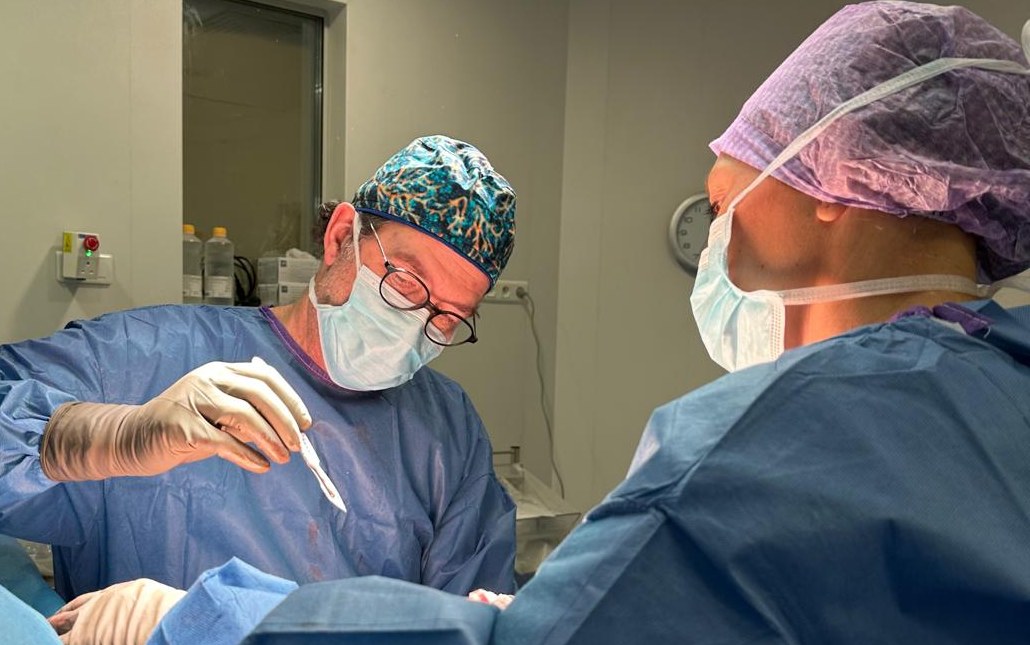
You must scrupulously follow the surgeon’s pre-operative instructions regarding preparation, hair removal and antiseptic showers. Asepsis measures are very strict where a breast implant is concerned, and antibiotics are given at the start of the anaesthesia. Your surgeon takes particular care over each step: incision, pocket, irrigation, no touch insertion with the Keller Funnel, local antibiotics, drain, suture.
The operation is assisted by illuminated binocular loupes for greater precision; the axillary approach is assisted by direct-vision or endoscopic instruments.
The compression bra is fitted at the end of the operation. Fine drains are kept in place for 12 to 24 hours when they appear necessary. Pain is managed during and after the operation with the greatest care: local anaesthetics, transdermal patches, painkillers, anti-inflammatories and muscle relaxants.
The success of your operation also depends on how the recovery is managed: do not hesitate to ask again for specific advice according to your personal activities.
In the short term: haematoma, infection, delayed healing, implant displacement. In the long term: unpredictable capsular contracture, implant malposition, asymmetry, premature rupture. These complications remain rare, but they must be stated. Should a re-operation be necessary, the implants are covered by the manufacturer’s warranty for 10 years, especially in the event of early rupture or capsular contracture.
Regular follow-up is necessary: a visit and clinical examination every year with your surgeon.
Ultrasound assessment on request. Implants last a minimum of 10 years; beyond that, close annual ultrasound monitoring is necessary to check their integrity and the absence of rupture.
Results are convincing after one to three months and final after one year. However, since an implant is a foreign body, unpredictable reactions may occur later, such as capsular contracture or late fluid collection around the implant.
The appearance of a late fluid collection around the implant, with swelling of the breast, should prompt you to consult. So should the appearance of an abnormal lymph node in the armpit.
Frequently asked questions
These answers reflect the content written and validated by the surgeon. Each one is written to stand alone, question by question.
Gallery
Cases operated on by Dr Azencot, photographed before and after surgery, in front and three-quarter views. Drag to compare. The captions — volume, shape and implant plane — are the surgeon’s own.
Photographs for information only — neither a commitment nor a guarantee of result. Every situation is unique and assessed in consultation.
Go further
Meet us
A first consultation is there to understand your request and tell you what is possible — including when the answer is that it is better to do nothing.
16 ter rue Ferrère
33000 Bordeaux
In cosmetic surgery, French law requires a detailed written quote and a cooling-off period of at least fifteen days between the consultation and the operation. No deposit may be requested during that period. Two consultations are required before any operation.